
What is DMLex?
DMLex is a data model for lexicography. It was specifically designed to accommodate the particular needs of lexicographic data. One of its key principles is the use of relations, which can link entries as well as entry elements within the same entry. This leads to simplified entry structures and greater entry mobility. The same entry—for example an idiom—can exist as a stand‑alone entry and at the same time be linked to all the lemmas it contains. The idiom can then be presented to the user:
- as a stand‑alone entry for the idiom only,
- together with one or all of the entries it is linked to,
although it exists in the source data only once. The use of relations makes data simpler and also easier for computers to process.
Lexonomy offers the tools and configuration options needed to create DMLex‑compliant dictionaries. It is also suitable for editing non‑DMLex dictionaries.
DMLex strandard on the OASIS website (PDF) (also as HTML)
A DMLex dictionary – what is it?
A dictionary is a DMLex dictionary if its structural layout strictly follows the Data Model for Lexicography (DMLex) standard. In Lexonomy, this means that the dictionary was created using one the the bulit in templates
CREATE DICTIONARY – TEMPLATES
or by using the standard components
CREATE DICTIONARY – CUSTOM DICTIONARY – STANDARD COMPONENTS
A dictionary stays DMLex-compliant if additional custom entry elements are added or if some of the standard elements are removed and not used. However, the hierarchy – the relationship betwen parents, children and siblings – must be preserved. In addition, in Lexonomy, the names of the DMLex elements must not be modified. They must remain as they are defined in STANDARD COMPONENTS. Additional custom elements can use any names.
What is not a DMLex dictionary?
A dictionary is not a DMLex dictionary if its entry structure does not observe the structure defined by DMLex. In Lexonomy, this means that the dictionary entry structure was created completely manually. It can also mean that the entry structure was created from a template or in CUSTOM DICTIONARY – STANDARD COMPONENTS and the components were additionally renamed or their hieararchy changed.
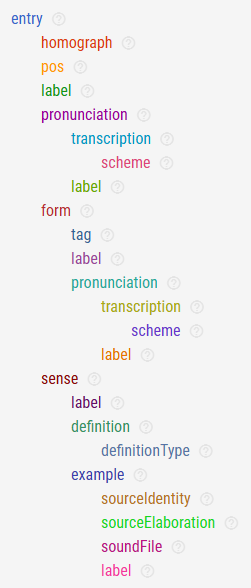
Core DMLex entry elements
These are the core elements. Unnecessary elements can be removed and additional elements can be inserted and the dictionary stays DMLex compliant as long as the hierarchy is preserved. Renaming the core elements is not allowed.
Examples
This dictionary entry structure is not DMLex-compliant because DMLex does not allow definition to be the child of entry. In Lexonomy, the standard entry elements must not be renamed, pos is required.
entry:
  partOfSpeech:
  definition:
This entry structure is DMLex-compliant because definition is the child of sense and the name of the part of speech element is pos.
entry:
  pos:
  sense:
    definition:
Examples
This dictionary entry structure is not DMLex-compliant because DMLex does not allow example and definition to be the children of entry:
entry:
  transliteration:
  example:
  definition:
This entry structure is DMLex-compliant because example and definition are the children of sense. The reversed order of example and definition is not relevant as long as both are children of sense.
entry:
  transliteration:
  sense:
    example:
    definition:
The transliteration element is not defined in DMLex and, therefore, its presence does not affect the DMLex compliance.